
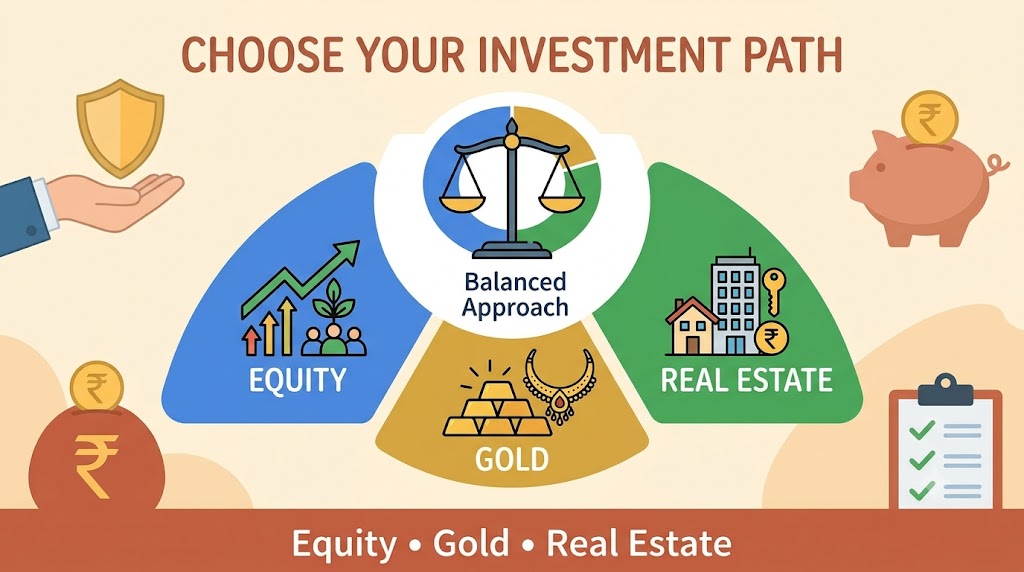
Choosing the right investment is no longer simply about finding the asset that delivers the highest return. Indian investors are increasingly weighing market volatility, inflation, liquidity, taxation and long-term financial security before deciding where to put their money. Against this backdrop, gold, equities and real estate continue to attract attention, although each serves a different purpose in a well-planned portfolio.
Gold is traditionally viewed as a store of value during uncertain times. Equities offer an opportunity to participate in corporate growth, while real estate appeals to investors seeking a tangible asset and potential rental income. However, none guarantees profits, and the right choice depends on an investor’s financial goals, time horizon and ability to withstand losses.
Equity: A Route to Long-Term Wealth Creation
Equities remain an important investment option for people seeking to build wealth over several years. By purchasing shares directly or investing through mutual funds, individuals can participate in the growth of Indian businesses across sectors such as banking, manufacturing, technology, healthcare and consumer goods.
India’s expanding economy and rising domestic consumption provide opportunities for companies to grow revenues and profits. Nevertheless, stock prices can fluctuate sharply because of interest-rate changes, inflation, geopolitical tensions, corporate earnings and foreign investor activity.
Recent market volatility in 2026 has reinforced the importance of looking beyond short-term movements. Systematic investment plans, or SIPs, allow investors to invest a fixed amount regularly, helping them develop financial discipline and avoid depending entirely on market timing.
For beginners, diversified equity mutual funds or index funds may offer a more manageable starting point than selecting individual stocks. Investors should still understand market risk and ideally maintain an investment horizon of at least five years or longer for equity-oriented goals.
Gold: A Hedge Against Uncertainty
Gold holds a distinctive place in Indian households, combining cultural significance with financial value. Demand often strengthens when investors become concerned about inflation, currency movements, geopolitical risks or uncertainty in financial markets.
Gold can help diversify a portfolio because its performance does not always move in the same direction as equities. However, its price can also decline, particularly when global interest rates, the US dollar or investor sentiment move against the metal.
Unlike shares or rental property, physical gold does not generate regular income. Jewellery also carries making charges and other costs that may not be recovered when it is sold. Investors seeking exposure without storing physical metal may consider regulated market-linked options, after understanding their costs, risks and applicable rules.
Gold is therefore best viewed as a potential portfolio diversifier rather than a substitute for every other investment. Its role is particularly relevant when an investor wants to reduce dependence on a single asset class.
Real Estate: Long-Term Potential With Lower Liquidity
Property remains attractive to Indian investors because it offers a tangible asset that may appreciate over time. Residential or commercial property can also generate rental income, depending on the location, tenant demand and purchase price.
Yet real estate requires substantial upfront capital. Registration charges, stamp duty, maintenance, repairs, property taxes and periods without tenants can reduce actual returns. Selling a property may take months, making it far less liquid than listed shares or many financial investments.
Location is a decisive factor. Employment opportunities, transport links, infrastructure development and access to essential services can influence demand and future prices. Investors must also examine legal title, approvals, outstanding dues and the financial viability of a property before purchasing it.
Real estate may suit investors with a long horizon and sufficient financial resources. However, concentrating most savings in one property can create risk, especially when an investor needs quick access to cash.
Comparing the Three Investment Options
Equity offers stronger long-term growth potential but comes with market volatility. Gold may provide diversification during uncertain periods, while real estate combines potential appreciation with rental income but involves high costs and limited liquidity. Past performance alone cannot establish which asset will perform best in the future.
Tax treatment also differs according to the asset, investment structure and holding period. Investors should check the latest applicable capital gains rules rather than assume that all investments receive the same tax treatment.
A Balanced Approach to Investing
For many investors, the decision need not be an exclusive choice between gold, equity and real estate. A diversified portfolio can combine assets according to individual needs. Equities may support long-term wealth creation, gold may help diversify risk, and property may serve a housing or income objective.
Before investing, individuals should maintain an emergency fund, manage high-cost debt and ensure that essential financial needs are covered. They should also assess how much loss they can tolerate without disrupting household expenses or business commitments.
Conclusion
India’s investment landscape offers opportunities across multiple asset classes, but returns depend on market conditions, purchase prices, costs and investment discipline. Equity can support long-term growth, gold can provide diversification, and real estate can offer a tangible asset with income potential.
The most effective investment strategy is not necessarily the one that follows the strongest-performing asset of the moment. It is the one that matches financial goals, balances risk and allows investors to remain committed through changing economic conditions.